
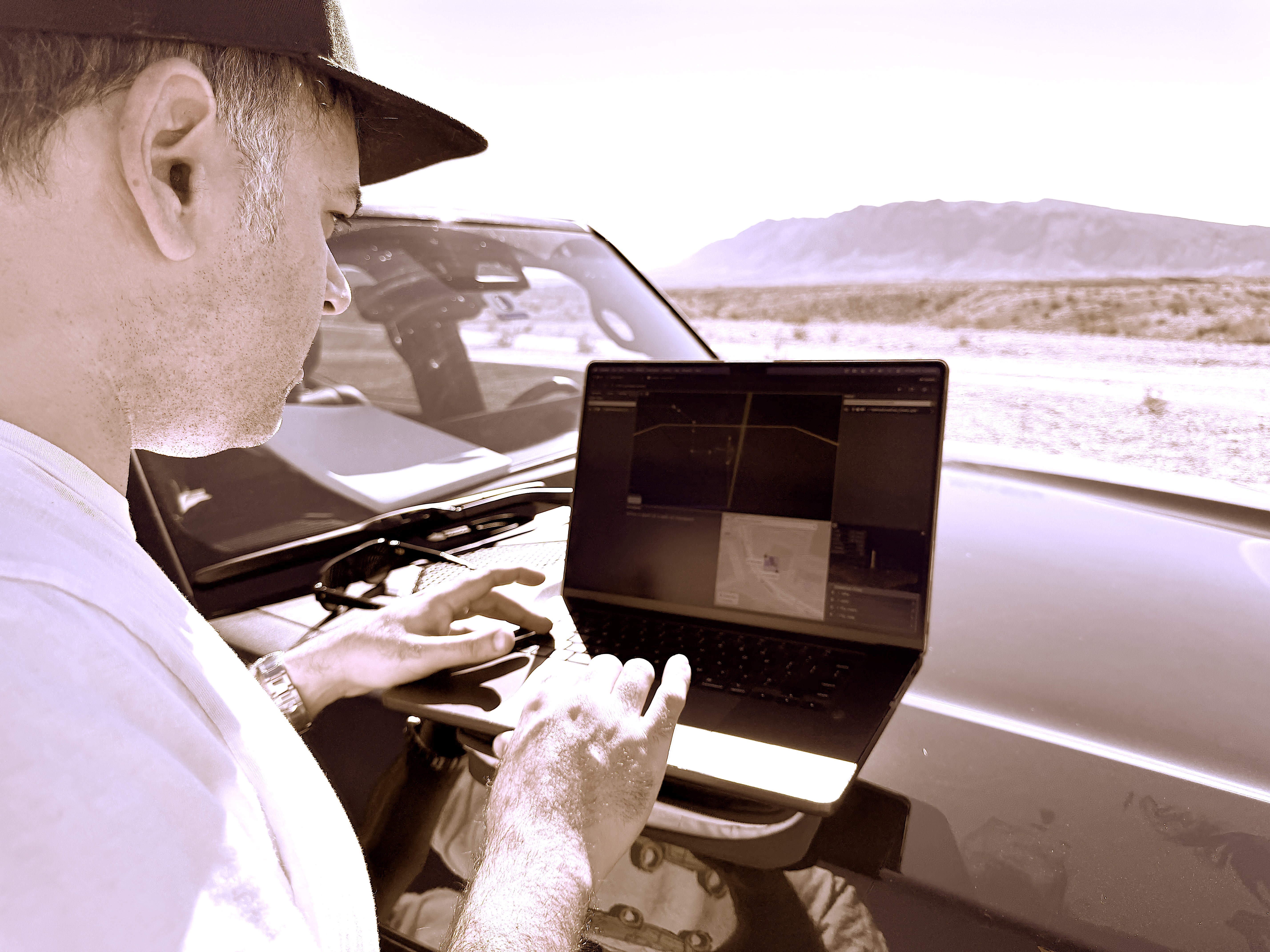
At augzoo, we don’t just build tools for augmented reality—we field test them where reality is at its toughest. Over the years, from cultural commissions in Austin to testing Starlink-powered AR in the wilds of Big Bend, we’ve developed a process we now call The Overland Method.
Like its namesake—overlanding, the practice of self-reliant travel through rugged, remote terrain—our method is about adaptability, endurance, and invention on the move. It’s not theory in a lab; it’s technology evolving in situ, shaped by the same environments and communities it’s meant to serve.
What defines The Overland Method?
Field-deployed development
We design and debug on location. Features aren’t just tested in a simulator—they’re walked through, captured, and stress-tested in the open world.Environmental resilience testing
Our tools go where cell towers thin out, where GPS drifts, and where light, terrain, and signal interference challenge every assumption.Minimal viable deployment
We bring just enough functionality to survive in the field, then iterate rapidly based on real-world feedback.Nomadic infrastructure
From Starlink to solar rigs to mobile caching strategies, we operate like creative expeditions, making the most of lightweight, flexible systems.Story as scaffolding
Every project—whether public art, cultural preservation, or our new Bilingual Dinosaurs—is both a test case and a storytelling platform. Creative content gives our technology purpose, and in return, the tech gives communities a new canvas.
Why it matters
Emerging technologies can’t be built in isolation. They have to weather the dust, the noise, the glitches, and the unexpected conditions of lived experience. The Overland Method ensures that what we’re building isn’t just functional—it’s resilient, accessible, and meaningful.
At its heart, The Overland Method is about more than development. It’s about forging technology and story in tandem, under conditions as real as the world it seeks to augment.